

God's Toys?
A Tale of Two Heresies

Jahr (جَهْر) — pronounced Jahr, from the Arabic root j-h-r meaning to speak out loud, to declare openly, to make public. It stands in contrast to sirr (secret, hidden).
This is the spirit of this Substack: to explore a wide range of issues while sharing my thoughts, feelings, doubts, convictions, and experiences openly and honestly, without disguise.
Jahr will navigate existential themes, philosophical questions, theology, mental health, pop culture, social affairs, and politics — always from my inquisitive, though not entirely uncharged, perspective.
The Kitchen
I vividly recall a very brief dialogue—albeit, significantly consequential—with my grandmother in 1994. I was 11 years old then.
I was sitting in silence with my grandmother in her kitchen as she handpicked the rice, with impressive dedication and immersion, in preparation for lunch.
I enjoyed being with my grandmother even if we were not doing or saying much—just looking at her was a pleasant experience.
She had a very docile but calming presence. She almost always smiled when she was looking at me, she never ever yelled at me, and her tone was usually dripping with love and patience.
Underneath that there was also a commanding presence. At the time she was nearing the end of her 70s—thin and frail but also sharp and active.

I also especially liked her kitchen—it felt safe and peaceful there.
It was relatively well-lit and wide with two ancient fridges, a simple stove, a modest sink, and at the middle there was a flimsy wooden table with a distinctly yellow paint coating.
In the background, I could hear the humming of the tired fridge engines, the buzzing of the ceiling fan, the sound and smell of water flowing through the old pipes, and the almost perfectly-timed sound of dripping water.
Then, out of nowhere, I interrupted the serene silence and asked her with utmost sincerity and inquisitiveness:
“Grandma? Why did God create us?”
She stopped handpicking the rice and her gaze seemed to sink into the plate for a moment.
Then, without looking at me, still fixating on the plate, she very calmly responded albeit with what I perceived as an undertone of tethered bitterness:
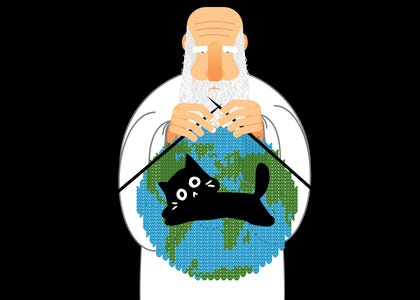
“Why did God create us? … We are God’s toys”.
She continued handpicking the rice with the same focus and dedication.
It was an unusual answer. Even as a child, I recognized that what she said was quite heretical which stood in stark contrast with her otherwise unwavering display of embodied and sincere faith in God.
But I was not bothered. For one reason or the other, I was already open to unorthodox answers to the usual questions. And perhaps that is what I was looking for. It probably was not the first time I asked somebody that question, and it most certainly was not the first time I explored that topic.
Yet, I still asked. This tells me I was not quite satisfied with the answers I have been given.
Sometimes I wonder if she simply tried to paint an endearing picture—an attempt by an adult to explain complex issues in a way that speaks to a child’s imagination.
But I don’t think so. It sounded and felt like her answer.
And perhaps there is good reason for that; my grandmother did not have an easy life.
Her mother died at an early age, and as the eldest child she had to step-in to take care of her many siblings (some of which did not survive either under her care). Her father, a rich pasha, was emotionally and physically distant—he was too busy and too distracted to be present. However, he remarried seven times throughout his life. All of his other wives also died young which meant my grandmother continued to play the role of the mother almost all her life.
Then in 1950s Egypt, the socialist revolutionary regime took almost all of her father’s assets—the houses, the land, and the businesses. At that point, she was married to my grandfather who was an ambassador and she was financially sorted just on that count. Yet, she was very bitter about Nasser’s regime. It was the loss of stature and perhaps the destruction of whatever remained of her already strained childhood normalcy that embittered her most.
Her first child, Tharwat, died just a few months after his birth. She never got over the ordeal—I saw her randomly cry over him many times even 50 years after.
Later, I would know that my grandmother suffered from severe depression and anxiety.
And so, perhaps the only way she could make sense of her experience in a cruel and seemingly indifferent world with God is thinking that “we are God’s toys”—mere objects of entertainment to a whimsical being.
Her answer stuck with me.
At the time, I did not accept it as the truth. But I was certainly intrigued and even humored by her answer. But above all, I empathized with her because I sensed she gave the answer in pain.
And that …
That remained.
Indeed, many years later, I remember one day she seemed to be in a debilitating nearly catatonic sadness. I asked her why she was sad and she said—with an unusual irritation—that she was “sad from God”.
Again, it was a shocking answer.
But I recognized her pain. And I remembered what she said about us being God’s toys.
If you were a toy, wouldn’t you be “sad from God” too?
I know I would be.
And, eventually, I too would find myself facing the prospect of us—all of this—being toys for God.
Or something potentially even worse. That is, the prospect of being abandoned toys.
Alas, whereas my grandmother’s reaction was sadness and bitterness, mine would be more visceral.
A House of Cards
Quite a bit later from that encounter in the kitchen, in the early 2000s, I was having a severe faith crisis. The reasons and the details are perhaps a story for another time. For now, I will highlight what I perceived as absurd theology (particularly Islam and Christianity), the problem of evil, and the morality of religious teachings and texts.
What first began as rejection of Islamic extremism turned into doubt of Islam altogether, followed by a failure of Christianity to inspire, and finally peaked into doubt of God’s existence—and ultimately, rejecting Him.
However, getting there took more than intellectual moves. It was an embodied experience of seeing the world as it is and not being able to separate it from what I would expect a world without God to look like.
There are several milestones—formative experiences and events—that dismantled my faith at the time.
The following is one of them.
Cat on the Street, Who in the Sky?
One afternoon, I was walking aimlessly on the streets of Cairo hoping to find relief from existential despair, incessant questioning, and the rude awakening to the horrors of the world without the scaffolding of faith.
I searched for a semblance of peace through the humming of the world’s locomotion and the company of random people. But my mind would not spare me and like a rip in the ocean, it dragged me into its ravenous abyss.
There was not much consolation in being around people pursuing their daily lives as if my apocalypse had not happened. To my eyes, they looked like fodder to the beast with ears that are deaf to the honing of whichever knife that would soon slaughter them. With every random person, my mind would play scenarios of their terrible demise reminding me of all the horrors that I witnessed before and all that I came to know about the brutal aspects of human history.
My heartbeat increased, almost racing, heralding the imminent advent of yet another panic attack. While still walking, I closed my eyes in a futile attempt to disarm the trigger, but there was no stopping the eruption of my emotions at this stage.
I yelled to myself, perhaps in my mind or in audible words: “I should not have left the house! I should not have left the house!”
And it was then, and despite my begrudging abandonment of faith in God, that I murmured to the sky: “Please God, if you are there, give me a sign, show me any goodness in this world”.
In Matthew (7:7) it reads:
“Ask, and it shall be given you; seek, and ye shall find; knock, and it shall be opened unto you”
Similarly, in the Quran (40:60) it reads:
“And your Lord says: Call upon Me; I will respond to you.”
And so I knocked, I called, and I screamed to God—in search for truth, comfort, or anything to break the silence.
Nothing could have happened. It wouldn’t have been the first time that I prayed towards nothing but a silent wall. And yet, there was some kind of an answer. Although, I am not sure what to make of it: a random coincidence? An honest answer that I did not like? Or perhaps the most profound interaction from the divine?
I opened my eyes and a few meters away I spotted a kitten by the pavement.
I hurled towards it with the eagerness of a drowning man towards a raft. For even in the darkest of worlds, there is something about the innocence of a new life that dispels the gloom.
However, what I found was yet another pariah like me.
The lower legs of the kitten were crushed to the ground like mush, and it was futilely trying to drag its body—which was viscerally stuck to the ground—away from the street as it moaned.
A car must have run over it.
My heart sank, my eyes widened in horror, and my lips trembled as I repeatedly mumbled, “No, no, no”.
At this point, I let out a screeching scream and for the first time in months, I felt something other than despair and sorrow: an insurmountable rage!
I ran away as fast I could while indiscernibly screaming until my legs could not carry me anymore. I collapsed on the pavement, hardly catching my breath while at the same time grunting for minutes like a rabid animal.
When I finally cooled down, I had an epiphany. While I did not find what I begged God for, I had inadvertently found a solitary candle in the darkest of worlds—my anger.
The questions were no longer: “Does God exist?”, “Why is there suffering in the world?”, or “What’s the point of it all?” Rather, it was one simple question: “How do I really feel about the world—as it is—with God or without Him?”
The answer was: unbridled, unapologetic, and untethered raw rage.
A used toy may be bitter at its owner. That was my grandmother.
But an abused toy? It can surrender or become rage incarnate. I was the latter.
At least for a moment.
And, like every moment, even if it must change, its truth is eternal.
Excellent writing style. I could see, hear and feel your words in your emotions.
Wow …this is a great piece of writing, I am speechless ❤️🩹❤️🩹