

"God has my Back"
How a Strong President Sisi Requires a Weak God

Jahr (جَهْر) — pronounced Jahr, from the Arabic root j-h-r meaning to speak out loud, to declare openly, to make public. It stands in contrast to sirr (secret, hidden).
This is the spirit of this Substack: to explore a wide range of issues while sharing my thoughts, feelings, doubts, convictions, and experiences openly and honestly, without disguise.
Jahr will navigate existential themes, philosophical questions, theology, mental health, pop culture, social affairs, and politics — always from my inquisitive, though not entirely uncharged, perspective.
Introduction
In June 2014, Field Marshal Abdel Fattah el-Sisi was sworn in as Egypt’s 6th president. El-Sisi won the 2014 presidential elections by a large margin against his Nasserist opponent Hamdin Sabahi, receiving 96.1% of the popular vote.
He was later re-elected in 2018 and 2023, securing 97.08% and 89.65% of the vote respectively against nominal opponents. In 2019, a constitutional amendment was approved by referendum — with 88.83% of voters supporting it — extending the presidential term from 4 to 6 years and granting El-Sisi a one-off allowance to serve beyond the standard two-term limit.
In what could be seen as a continuation of the events that led to the ouster of President Hosni Mubarak in February 2011 amidst the January 25 revolution, El-Sisi’s rise to power followed the aftermath of yet another ouster of a sitting president.
In July 2013, President Muhammad Morsi — the Muslim Brotherhood’s candidate who had been narrowly elected just a year prior — was removed from office by the Egyptian Armed Forces after a massive wave of protests.
Led by El-Sisi, who was Defense Minister at the time, the move to overthrow Morsi had considerable popular support on the streets and the approval of a broad coalition that included al-Azhar, the Coptic Orthodox Church, the Salafi Nour Party, the youth-led Tamarod movement, the Egyptian Armed Forces, the judiciary, and opposition leaders such as Mohammed El-Baradei.
Like any worldly event, the downfall of Morsi and El-Sisi’s ascension to power could be attributed to a cascade of factors, prior events, and decisions.
First, the broad discontent with Morsi’s governance.
His controversial power grab through the November 2012 decree and the rushed passage of the 2012 constitution cast doubt on his commitment to democracy, alienating both adversaries and allies not aligned with the Muslim Brotherhood. Coupled with administrative failures like power cuts, gas shortages, and railway accidents, there were significant erosions in public trust.
Additionally, various segments of Egyptian society grew increasingly dissatisfied and concerned with the Muslim Brotherhood’s social and political agenda — including key players such as the Coptic Orthodox Church, the judiciary, and Al-Azhar.
Second, social and political divisions which led to a profound isolation of the Muslim Brotherhood and Morsi in their last days in power.
With the revolutionary movement irrevocably fractured by mutual mistrust and bloody confrontations on the street, Morsi hardly had any effective support from outside his base and sympathizers. This would prove to be detrimental not only to Morsi’s hold on power but also to the fate of his supporters.
In August 2013, the pro-Morsi sit-ins in Rabea and al-Gam’a Squares were dispersed in violent confrontations between the police and armed protesters, leading to the death of hundreds — including security personnel, armed militants, and unarmed protestors.
Third, national security concerns that contributed to a deeply divided Egypt.
These were heightened by the bloody confrontations on the street, which seemed to signal that Egypt was on the brink of civil war, as well as the Sinai Attacks in August 2012 and April 2013 against military and police personnel. Additionally, Morsi’s vow to “heed the call of Syria” against Bashar al-Assad raised concerns that Egypt was about to be implicated in a fateful regional quagmire.
After Morsi’s ouster, Egypt was hit by a wave of terrorist attacks targeting security personnel, government figures and institutions, security checkpoints and outposts, churches, and on one occasion a mosque in Northern Sinai. This further cemented the broad sentiment that Egypt needed a strong ruler and affirmed the military’s status as the only viable guarantor of security and stability.
Fourth, the potential external influences.
There were whispers of conspiracies within the state — a secret alliance between the military, business conglomerates, and unsympathetic sections of the media. Regional powers such as Saudi Arabia and the United Arab Emirates were also politically and economically supportive of post-Morsi Egypt, signaling a broad regional policy among key players to stop the advance of the Muslim Brotherhood.
Fifth, the unremarkable demise of the spirit of the revolution.
With all the aforementioned factors, a considerable portion of Egyptian society looked at the Armed Forces as the only viable savior. Some of the chanting on the streets during the June and July 2013 protests explicitly called for El-Sisi, as the leader of the Egyptian Army, to intervene.
At that juncture, it did not matter whether veteran protestors from January 25 approved or disapproved of this development. It was a broad sentiment that swept the demonstrations — and they were there — which inadvertently signaled that the revolution had reached a dead end, lending the military intervention legitimacy and urgency.
Sixth, El-Sisi’s autocratic rule and repressive practices.
El-Sisi undeniably enjoyed considerable popularity, especially in the months that followed Morsi’s ouster. However, not everyone was on board with his rise to power. Accordingly, his grip on power is also maintained by squashing dissent, neutering the political sphere, weaponizing the state security apparatus, silencing opponents, and exercising near-absolute control of the press.
Over the years, El-Sisi has provided numerous insights into Morsi’s tumultuous year in the presidency. He adamantly denies any conspiracies, instead emphasizing — through personal anecdotes and broad commentary — that Morsi and the Muslim Brotherhood were caught in a web of their own making.
It appears that El-Sisi is well aware of the principle that worldly events are shaped by worldly conditions. Indeed, and regardless of his intentions, he effectively orchestrated Morsi’s removal from power — a fateful move that must have required careful calculations, the establishment of alliances, a keen understanding of public opinion, anticipation of potential international reactions, and painstaking planning for the day of ousting Morsi and its aftermath.
That said, El-Sisi has explicitly referenced what might be, in his view, an overriding factor amidst the otherwise material conditions that contributed to his rise to power: destiny and a covenant with God.
Throughout the years, and in his signature unscripted monologues, El-Sisi has made several extraordinary claims — of possessing the paranormal power to foresee the future, and of having a personal kinship with the divine.
I will argue that while such claims are clearly unorthodox, they are not necessarily absurd within the context of Egypt’s cultural landscape and the broader concept of the postmodern era. That El-Sisi makes such claims is not necessarily explained as delusions or political theatrics.
Rather, El-Sisi’s claims could be seen as a manifestation of a key feature of modern thought where absolute certainties are challenged, and totalizing truths are undermined by the lived realities of people — including conceptualizations of God.
By emphasizing hermeneutics instead of metaphysical and epistemological certainties, God remains relevant in the postmodern world, and most certainly in El-Sisi’s world — albeit in a manner that allows more freedom from the dictates of authoritative texts. This allows El-Sisi to shape his messianic discourse by drawing from the power of God while not being constrained by principled interpretations of His will.
El-Sisi’s Claims of Divine Kinship
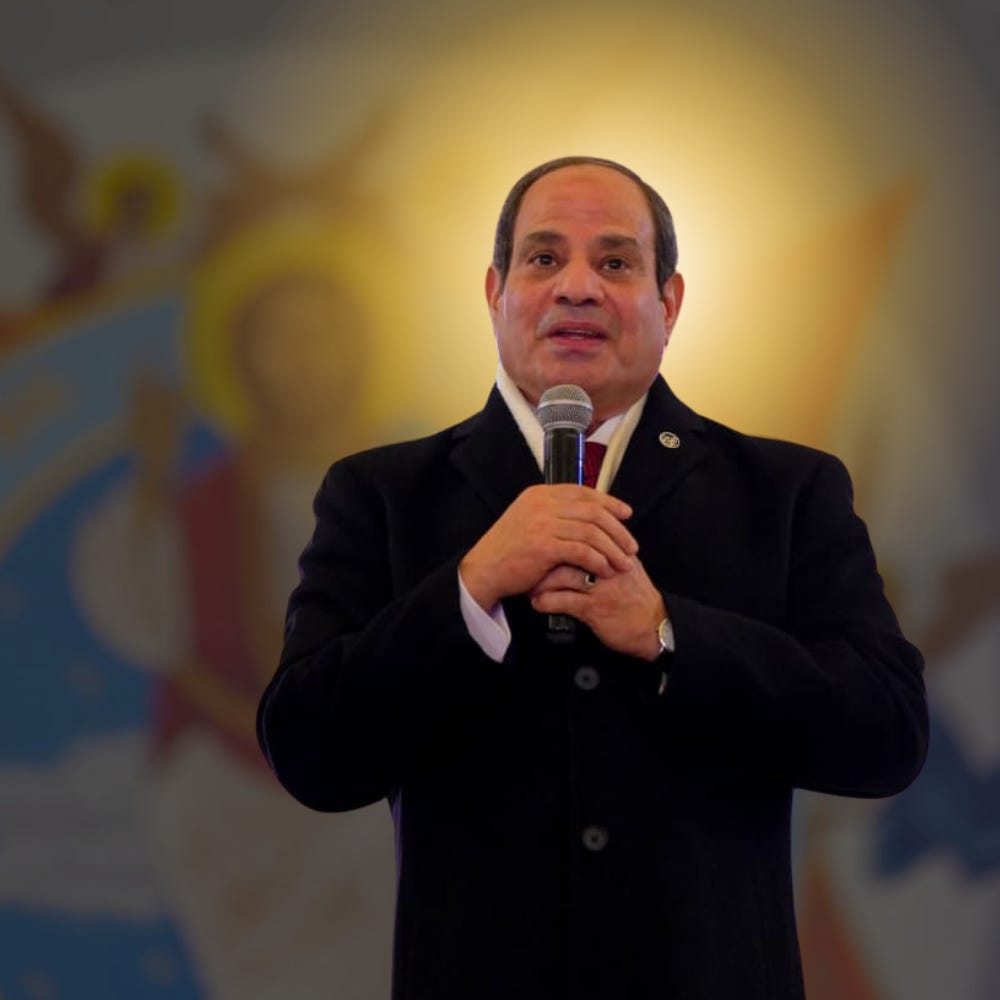
El-Sisi is known for his seemingly unscripted monologues and improvisations in his speeches and at local conferences. Always eager to fire from the hip, he hardly misses a chance to chime in on his version of the events of January 25 and those that led to the ouster of Morsi.
On several occasions, El-Sisi has recounted what he considers to be profound paranormal and spiritual experiences — including manamat (precognitive dreams) and direct dialogues with God.
For instance, in an unverified off-the-record interview with journalist Yasser Rizk, leaked by Al-Jazeera in December 2013, El-Sisi recalled a series of seemingly bizarre dreams that he believes foretold his ascent to power.
In one dream, he saw himself brandishing a sword inscribed with the Islamic shahada — “la ilaha illa Allah” — in red. In another, he was wearing an Omega watch adorned with a large green star. When asked about the watch in the dream, he replied: “What is the name of this watch? It’s Omega, and I am Abdel Fattah.” El-Sisi explained to Rizk that he associated Omega with universality, connecting it to his own name, Abdel Fattah — though the exact meaning remains elusive.
In the same interview, El-Sisi described a dream where he was told: “We will give you what we have not given to anyone.” In yet another dream, he found himself with former President Sadat, who told him: “I knew I was going to be the president” — to which El-Sisi replied: “And I know I will be the president.”
This is particularly striking. It shows that at some level, during Morsi’s presidency, El-Sisi already believed he would be Egypt’s president. Whether this influenced his decision to oust Morsi cannot be determined — but it most certainly calls his intentions into question.
In a July 2021 televised speech, El-Sisi recounted a time when he would pass by impoverished areas and wish that things would change. He would tell God: “If I have private money, I will change this, my Lord.”
El-Sisi recalls doubts from others who told him he was dreaming — that even if he had the means, he would not spend money on those areas. But El-Sisi says that God “came” and said:
“I will give you more than money. I will give you barakah (Blessings). Show me what you are going to do for your country and what you are going to do for your people. Are you really going to change things? Are you really going to fix the circumstances? Are you really going to satisfy people? Are you really going to please people?”
As I will discuss later, there is nothing radical about believing in divine intervention — God’s direct involvement in worldly affairs is a core tenet of Islamic theology.
What is remarkable, however, is that El-Sisi ascribed to God a dialogue from outside the Qur’an. This implicitly — even if unintentionally — places El-Sisi in the status of prophets, or at the very least that of Awliya Allah (Friends of God): highly devoted Muslims believed to possess such exceptional faith and piety that God bestows special blessings and graces upon them.
On separate occasions, El-Sisi has alluded to the idea that God wants and supports him in the presidency.
In a speech in December 2021, he proclaimed: “I have no fear. Age belongs to God and the place I am in belongs to God. Whenever He tells me let’s go, I will salute Him and leave.”
In the same speech, however, El-Sisi expressed his wish to be held accountable on Judgment Day for every measure taken — suggesting he is certain of his own goodwill and intentions, while leaving the final judgment to God.
In an October 2020 speech, El-Sisi foreshadowed a confrontation with his critics on that same Day, saying: “By God, I will make my case before everyone on the Day of Judgement, in front of our Lord, about everything that we did.”
In a speech in October 2022, El-Sisi said people would ask him: “Why do you speak of God so often?” To which he replied: “I love Him, and He is precious to me.” He added: “I am the one who saw what He did for the country and His generosity is beyond imagination.”
Later in the same speech, addressing the prospect of being betrayed, El-Sisi affirmed: “God has my back. If someone can defeat God, go ahead.”
In a July 2022 speech, El-Sisi praised his own efforts in development as “unprecedented work” accomplished by God, saying: “I have the honor, pride, and all satisfaction for His support that I could do all of this.”
After asking his audience not to think he was making false claims on behalf of God or exaggerating, he reiterated: “God protected this country” and “God will protect this country.”
Yet almost a year later, it seemed El-Sisi was not entirely certain of future divine intervention. In a June 2023 speech, he emphasized the importance of remembering the past — perhaps alluding to the events of January 2011 and their aftermath — and warned: “If God has saved you once, do not expect Him to save you every time.”
While associating himself with God might suggest El-Sisi implicitly claims infallibility as much as humanly possible, he often reminds his audience of divine sovereignty over all of humankind — including himself.
In a January 2024 speech, El-Sisi rebuked claims that he was obstructing aid for Gaza — which, at the time of writing, is under intense Israeli military operations that have left tens of thousands dead, hundreds of thousands displaced, and much of the enclave destroyed. He exclaimed: “Where would I go from God if I am the reason?”
This is by no means an exhaustive account. Numerous other speeches and monologues likely contain further references. But these examples are enough to draw broad outlines of El-Sisi’s claims of divine kinship:
First, El-Sisi claims that God speaks to him directly.
Second, God is intimately involved in Egyptian affairs.
Third, El-Sisi has special knowledge of this involvement.
Fourth, El-Sisi’s leadership is destined — a mission foretold by visions and one that God Himself is party to.
Fifth, God has saved Egypt, but this salvation — implicitly embodied in El-Sisi’s presidency — is not final. It is contingent on not repeating the mistakes of the past (including, rather paradoxically, the mistakes of Mubarak and those of January 25, among them the rise of the Muslim Brotherhood to power).
Sixth, God has absolute sovereignty over everyone — El-Sisi included.
A Strong Sissi, a Weak God
In Islamic doctrine, God is not just the maker of a clockwork universe. The Qur’an also depicts God as directly involved in the world — not only as its creator, but as its sustainer. Natural phenomena are presented as the work of God, from the growth of plants to the movement of celestial objects.
This extends to human affairs, which God is likewise depicted as intimately involved with. The Qur’an provides a history of God’s relationship with humankind that began with purpose and intent. As the Qur’an unequivocally tells us, God created humankind to worship Him. There seem, however, to be broad aspects of what constitutes worship. The Qur’an also mentions that God made humankind as His vicegerent on Earth to populate it, that humankind agreed to bear this responsibility, and that human life is ultimately a test — so that God can reward and punish people in the afterlife.
Crucially, the Qur’an recognizes that without revelation, humankind may hold a valid argument over God’s judgment. In doing so, it establishes God’s responsibility to announce His presence and inform humanity of His will. The Qur’an states that God would not punish people if He had not first sent messengers to them.
And indeed, the Qur’an is rife with stories about the prophets who preceded Muhammad and their nations. It also highlights standards of divine revelation — clarity and coherence — and claims to fulfill them, explaining that meeting these standards is necessary so that people can recognize the message as coming from God.
In short, only God can reveal Himself in direct speech, because only He can produce a message whose features confirm its divine origin. That is why the Qur’an describes Muhammad as merely a human who does not utter words based on his own desires. And crucially, the Qur’an explicitly declares Muhammad to be the seal of the prophets — meaning that, on the Qur’an’s own authority, no one after him can claim to receive direct messages from God.
While El-Sisi does not claim to be a messenger from God, he openly ascribes words to God from outside the Qur’an, presenting them as direct conversations. This sits within a broader self-portrayal of an exceptional relationship with the divine.
Islam does establish that communication with God — without barriers or mediators — is possible. But this is not the same as ascribing specific words to God, which does not align with fundamental Islamic teachings about prophethood and divine revelation.
So why have El-Sisi’s monologues about divine kinship not elicited significant objections?
One explanation is that El-Sisi’s regime does not allow dissent of almost any kind. Even if people within Egypt object to El-Sisi’s potential heresies, delusions, or near-prophetic claims, they cannot air those objections without facing dire consequences.
Another reason is that El-Sisi’s regime exercises near-absolute control over the media. Under his rule, the previously robust and diverse private media landscape was systematically consolidated. It is not necessarily the case that objections do not exist — rather, those who hold them are either excluded from the public sphere entirely or practice self-censorship.
Additionally, some may argue that there is nothing fundamentally exceptional about El-Sisi’s claims. While they may be at odds with Islamic orthodoxy, aspects of the lived realities of Muslims across Muslim-majority countries (MMCs) also diverge from orthodox beliefs — more on this shortly.
Widespread belief in God’s intimate involvement in human affairs, and the acceptance of a private relationship with God as the norm, may lend some credibility to El-Sisi’s claims. This is further reinforced by the widespread belief that Egypt holds an exceptional worldly status — colloquially called Um al-Donia, or Mother of the World — as well as a divine one, having been mentioned in the Qur’an. Add to this the historical functionalization of Islam by successive leaders since the era of Muhammad Ali, and it becomes more conceivable that God is involved with Egyptian affairs in an exceptional manner — including divine stewardship of the country and divine kinship with its purported selfless and devoted servant, El-Sisi.
While there is room for much further speculation, and many threads to follow, this article focuses on conceptualizing God as a social actor in the modern world. This follows Samuli Schielke’s call for anthropologists studying MMCs to theorize the power of God in ethnographic examinations.
Anthropologists in MMCs are not unmindful of the significance of God in Muslim societies. Rather, Schielke is calling for the systematic inclusion of God — and specifically “the quite tangible acts and presence of God in relations among humans.” In El-Sisi’s case, the role of God is central to his discourse, which warrants taking his claims seriously — not because they must be metaphysically true, but because the conditions from which they arise and their consequences are tangible.
This is especially important in a context of ambivalence that characterizes modern life in Egypt and elsewhere. And even more so if we seek to understand how traditional religion has adapted to the conditions of modernity — and how God survived his assassination attempt. A core assumption I am making is that totalizing truths are undermined by the lived realities of people.
Philosopher Gianni Vattimo unpacks this historical moment with what he calls “weak thought.” Weak thought symbolizes the postmodern world by rejecting absolute certainties and truths. It shares with the postmodern perspective the impulse to challenge and deconstruct foundational truths and reasons. However, it diverges in one significant way: it avoids slipping into relativism by emphasizing hermeneutics instead of metaphysical and epistemological certainties.
As Vattimo and Rovatti argue: “rationality must de-potentiate itself, give way; it should not be afraid to draw back toward the supposed area of shadow, it should not let itself be paralyzed by the loss of the luminous, stable, Cartesian point of reference.” Rather than relying on rigid, foundational truths, they propose a more interpretive approach to understanding the world. Rationality should be flexible — unafraid to move away from a single, stable reference point for knowledge and truth.
In other words, absolute certainty is no longer tenable in the postmodern era, where complexity, ambiguity, and interpretation play more significant roles in our understanding of truth and reality. By making rationality malleable — and rather than slipping into relativism — we can respond to the world reflexively, acknowledging the diversity of perspectives and interpretations without succumbing to the belief that all truths are equally valid.
Vattimo and Rovatti further explain that “weak thought is thus certainly a metaphor and, to some extent a paradox... It points out a path; it indicates a direction of the route; it is a way that forks from the no matter how masked hegemonic rationality [ragione-dominio] from which, nevertheless, we all know a definitive farewell is impossible.”
Weak thought is paradoxical because it challenges the dominant rationality of the time while acknowledging that this rationality can never be entirely abandoned. But this is precisely what made it effective — and perhaps what lent resilience to traditional religious beliefs. It opened a new path of understanding the world while maintaining some commitment to the prior dominant rationality.
As Grimshaw explains, “Vattimo opens up a new possibility of weak thought that posits weak religion against strong fundamentalist and dogmatic religion, weak God against strong God, and weak politics and democracy against strong politics that is totalising in all its expressions, including, perhaps most importantly, that of limiting, exclusive liberal democracy.”
In this sense, a strong God would be the one who revealed absolute truth to humankind and expects their obedience — knowable through the study of Islamic texts and adherence to a particular Islamic orthodoxy. The weak God, by contrast, is one whose voice is borrowed and transformed to encapsulate alternative and reflexive meanings more suitable for the times, without completely severing them from the dominant rationality.
In hermeneutic understandings of God, divine will — and even Godhood itself — is interpretive and contextual. The duality of Godhood, while not a foundational assumption within Islamic orthodoxies, constitutes an important aspect of faith in God across MMCs.
As Aliakbar Jafari and Ahmet Süerdem note, in consumer practices in MMCs, the sacred and profane are “symbiotically present.” They illustrate this with examples such as an Iranian woman who prays daily but also attends mixed-gender parties; Turkish Muslims who drink alcohol to celebrate the end of Ramadan; Jakartan families who go to Friday prayers and then engage in “hedonic shopping”; and Arab students in Dubai who enjoy the “grandeur of Islamic mysticism” in lavish restaurants, where sheesha is served and pop music plays in the background.
Jafari and Süerdem argue that in these instances, “the Halal (lawful) and Haram (unlawful), the Mustahabb (favoured) and Makruh (disliked), and the Islamic and un-Islamic are all juxtaposed to shape the mundane consumption practices of these people.” They further argue that such practices are “obvious paradoxes” reflecting “the effects of globalization of consumer culture” and are “grounded in very ordinary cultural habits of the indigenous people of each society.”
However, there is nothing paradoxical about this if Godhood branches into a strong God — whose judgment is absolute — and a weak God — whose judgment is diluted by the ambiguities of modern life.
This leads me to argue that pious nuances within impious behaviour, or what I call (im)piety, is a significant form of Islamic praxis in modern times. Within the framework of (im)piety, sinners in Islam seek forgiveness and promise repentance through their personal relationship with God. They believe that God, who expects obedience and reverence, will reward or punish them in this life and the afterlife. They also believe that God listens to prayers, can intervene in all events, and serves as a mediator between Himself and sinners. And despite knowingly transgressing His rules, the (im)pious expect God to show mercy and patience — relying on His benevolence to avoid His wrath and judgment.
It is still remarkable, of course, that El-Sisi invokes the Divine presence in the manner that he does. Not even the Islamist Morsi emphasized God’s presence as much — let alone in the same manner. But this should not come as a surprise. While hermeneutic understandings of God are an aspect of belief in general, the key takeaway is not that Islamic orthodoxy — with a strong God at its centre — is impossible. Rather, it is that the gravitational pull of such belief is not absolute, and is also relative.
One could argue that any faith in God is fundamentally hermeneutic, since it either involves an interpretation of a text or the layering of divine involvement onto events in the natural world — which is inherently interpretive. If every strong God must therefore also be a weak God, the distinction loses its explanatory power.
This would be a valid objection if the weak-strong hypothesis implied two mutually exclusive categories. But as analytical categories, they coexist on a continuum rather than on separate planes of imagination.
Literalists and fundamentalists could argue that their religious texts are unambiguously clear, and that certain events can be described without question as manifestations of divine intervention. They would insist that their understanding is the only correct one — and that therefore only a strong God exists. Be that as it may, the weak-strong distinction is not a metaphysical claim about the nature of God. Rather, it is an explanation of two things: (i) the multiplicity of forms that God takes as a social actor, and (ii) the variable ways in which divine will and divine action are identified.
The question, then, becomes one of proportion rather than outright exclusion: how much is dictated within the frames of a particular Islamic orthodoxy and its literalist interpretation of a text, and how much is left for hermeneutics?
In that regard, El-Sisi’s claims of having a relationship with God are significant but not extraordinary. They do not necessarily detract from invoking a strong God, because they are broad enough to fall within the purview of literalist interpretations of religious texts and core Islamic tenets — which dictate that a personal relationship with God, one of devotion and submission to Him, is not only possible but the very purpose of creation.
However, the more specific, special, and detailed the claims become, the closer they move toward a weak God on the continuum. El-Sisi’s claims of divine kinship are a stronger claim than simply having a personal relationship with God. The exceptionality is twofold: it requires that El-Sisi possess exceptional piety and religious knowledge, and it demands greater obscurity in the dictates of religious texts.
Yet while claims of divine kinship are unquestionably unorthodox, they are not necessarily absurd within the imaginative parameters of Egyptian culture or Islamic belief more broadly. El-Sisi’s strong invocation of God as a guardian for Egypt and for himself implies an interventionist God capable of a significant personal relationship with individuals — and there is hardly anything controversial about that as a matter of principle.
But El-Sisi’s claims go further still. Not only does he assign to himself the special status of knowing and understanding divine will, and not only does he claim paranormal abilities, but he also claims to engage in direct conversations with God — which he quotes verbatim.
This significantly removes El-Sisi’s claims from the gravitational pull of any strong God. In a sense, El-Sisi and God become almost synonymous: El-Sisi assigns words to God and presents some of his own decisions as manifestations of divine will. Within Vattimo’s framework, this requires not just a weak God, but a substantially weak one.
In other words, a strong El-Sisi — one who draws his power from God — demands a weak God. And the stronger El-Sisi’s claims of divine kinship become, the weaker that God must be. In one fell swoop, El-Sisi makes himself a manifestation of divine will, legitimizing his own authority, while subtly challenging more disciplined approaches to imagining God — and in doing so, delegitimizing his opposition.
Final Words
The discussion in this article did not dismiss El-Sisi’s claims of divine kinship and paranormal powers on naturalistic grounds. This is not to imply that such claims — from El-Sisi or others — are exempt from intellectual rigour and scrutiny.
Rather, I have maintained the position of taking them seriously: not because they are metaphysically true, but because the conditions from which they arise, and their consequences, are tangible — as real as any natural event. By examining El-Sisi’s claims against the backdrop of modern thought, we can make sense of not only how El-Sisi deploys God in his narratives, but also why his unorthodox claims find a place within Egypt’s cultural landscape.
It is important to note that this article has not provided a complete or definitive explanation of El-Sisi’s claims. While I believe my argument presents an angle worthy of consideration, I am not oblivious to the less abstract, more familiar mechanisms by which an autocratic ruler like El-Sisi attempts to control public narrative and suppress dissent and opposition.
Nor am I oblivious to the wider discussion of how the counterrevolution managed to both disarm revolutionary fervour from targeting it and weaponize it against Morsi. Related to this, the missteps of the Muslim Brotherhood and Morsi — which potentially include their overestimation of the public mood and appetite for their vision of Egypt — should not be glossed over.
Another angle worthy of consideration is El-Sisi’s psychological profile: his upbringing, personal beliefs, ambitions, and the ways in which he conducted and presented himself to elite leaders in the Egyptian military and, later, to President Morsi.